


ADVISORY ON ENTRY, TESTING AND QUARANTINE PROTOCOLS IN THE PHILIPPINES EFFECTIVE 01 FEBRUARY 2022
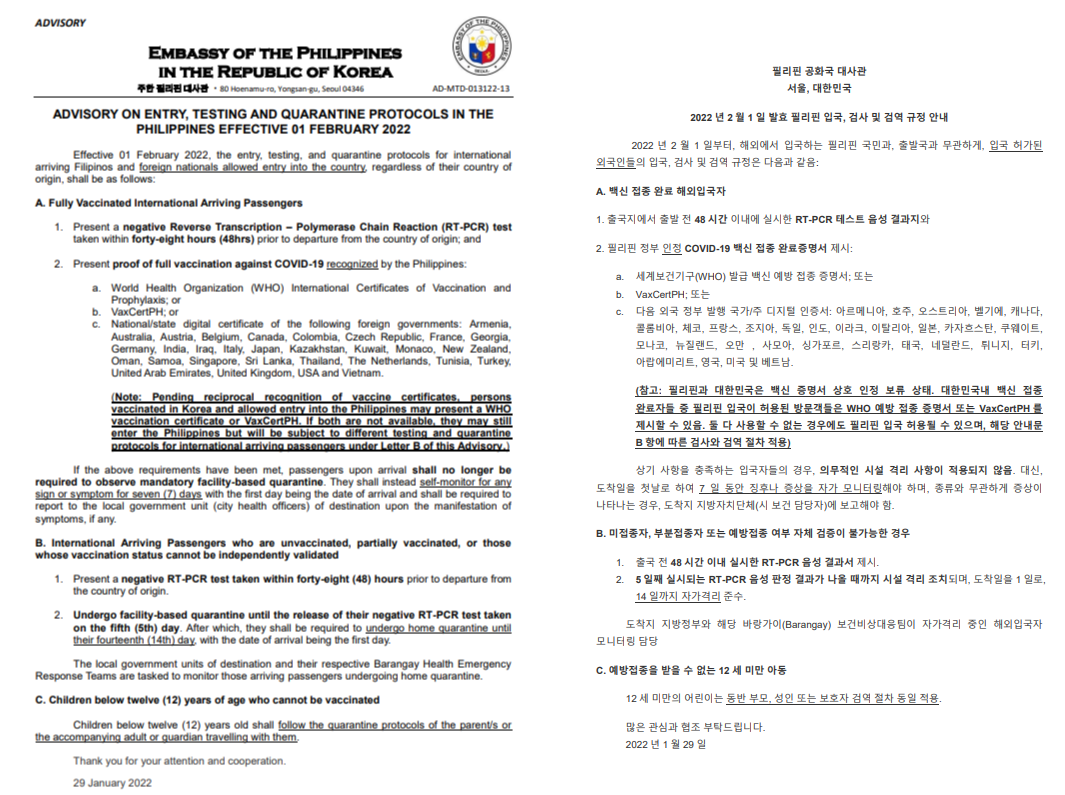
Effective 01 February 2022, the entry, testing, and quarantine protocols for international arriving Filipinos and foreign nationals allowed entry into the country, regardless of their country of origin, shall be as follows:
A. Fully Vaccinated International Arriving Passengers
1. Present a negative Reverse Transcription-Polymerase Chain Reaction (RT-PCR) test taken within forty-eight hours (48hrs) prior to departure from the country of origin; and
2. Present proof of full vaccination against COVID-19 recognized by the Philippines:
a. World Health Organization (WHO) International Certificates of Vaccination and Prophylaxis; or
b. VaxCertPH; or
c. National/state digital certificate of the following foreign governments: Armenia, Australia, Austria, Belgium, Canada, Colombia, Czech Republic, France, Georgia, Germany, India, Iraq, Italy, Japan, Kazakhstan, Kuwait, Monaco, New Zealand, Oman, Samoa, Singapore, Sri Lanka, Thailand, The Netherlands, Tunisia, Turkey, United Arab Emirates, United Kingdom, USA and Vietnam.
(Note: Pending reciprocal recognition of vaccine certificates, persons vaccinated in Korea and allowed entry into the Philippines may present a WHO vaccination certificate or VaxCertPH. If both are not available, they may still enter the Philippines but will be subject to different testing and quarantine protocols for international arriving passengers under Letter B of this Advisory.)
If the above requirements have been met, passengers upon arrival shall no longer be required to observe mandatory facility-based quarantine. They shall instead self-monitor for any sign or symptom for seven (7) days with the first day being the date of arrival and shall be required to report to the local government unit (city health officers) of destination upon the manifestation of symptoms, if any.
B. International Arriving Passengers who are unvaccinated, partially vaccinated, or those whose vaccination status cannot be independently validated
1. Present a negative RT-PCR test taken within forty-eight (48) hours prior to departure from the country of origin.
2. Undergo facility-based quarantine until the release of their negative RT-PCR test taken on the fifth (5th) day. After which, they shall be required to undergo home quarantine until their fourteenth (14th) day, with the date of arrival being the first day.
The local government units of destination and their respective Barangay Health Emergency Response Teams are tasked to monitor those arriving passengers undergoing home quarantine.
C. Children below twelve (12) years of age who cannot be vaccinated
Children below twelve (12) years old shall follow the quarantine protocols of the parent/s or the accompanying adult or guardian travelling with them.
Thank you for your attention and cooperation.
29 January 2022
 October 29, 2026
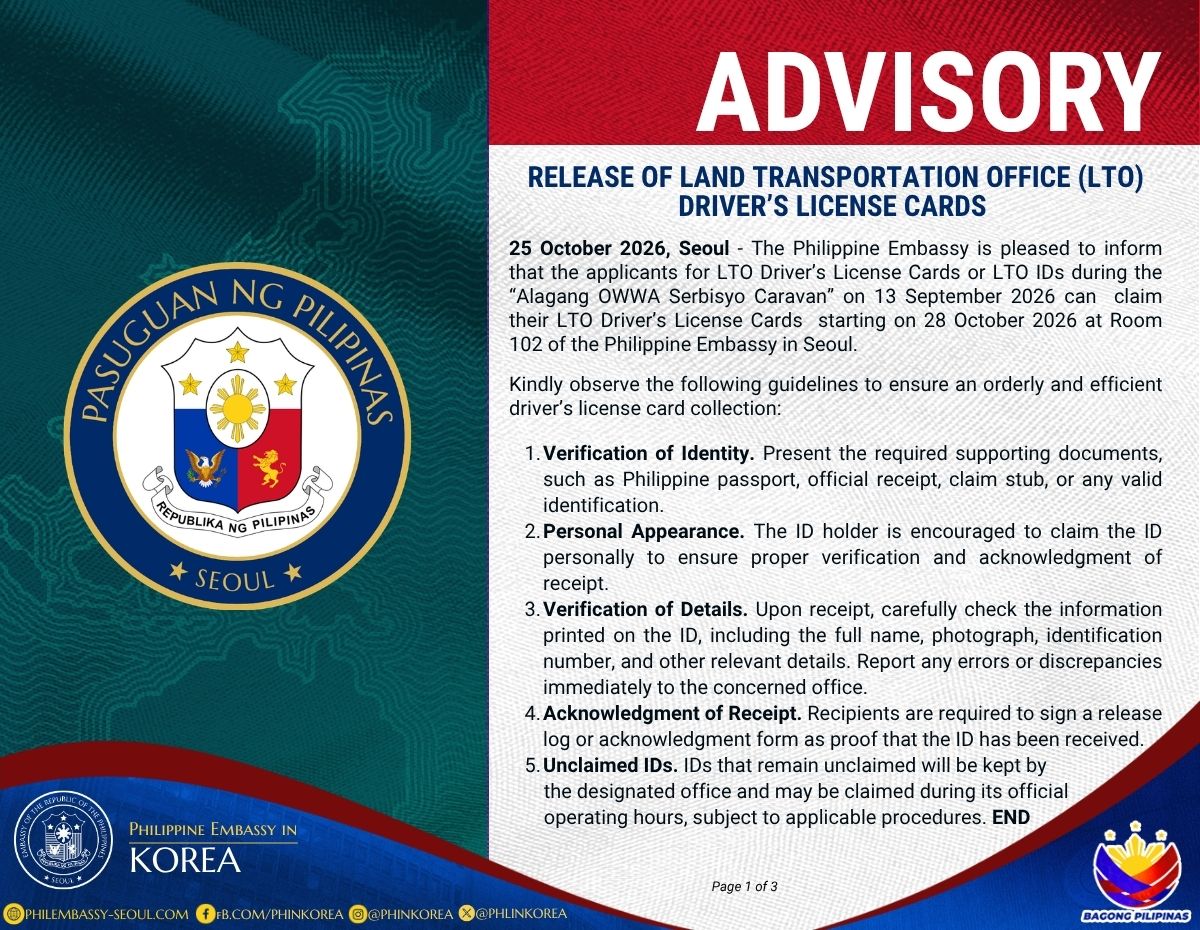 October 25, 2026
 October 19, 2026
