


PHL'S SUCCESSFUL PPP MODEL HIGHLIGHTED AT UNESCAP CONFAB IN KOREA
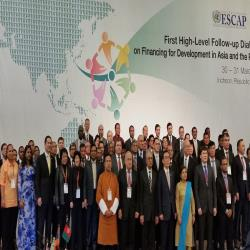
Philippine Ambassador to South Korea Raul S. Hernandez (3rd from left), Honorable Gil S. Beltran, Undersecretary and Chief Economist of the Department of Finance (4th from left) and Bureau of Internal Revenue Commissioner Kim Jacinto-Henares (5th from left) posing with the Honorable Cho Tae Yul, Minister of Foreign Affairs of the Republic of Korea (11th from left) and UN Undersecretary General and UNESCAP Executive Secretary Shamshad Akhtar (12th from left) and other dignitaries during the Opening Ceremony of the "First High-Level Follow-Up Dialogue on Financing for Development in Asia and the Pacific", 30 March 2016, Sheraton Grand Incheon Hotel, Incheon city, ROK.
SEOUL, 31 March 2016 - The Philippines' success in public-private partnership (PPP) and tax mobilization efforts were highlighted at a high-level dialogue hosted by the UN Economic and Social Commission for Asia and the Pacific (UNESCAP) on 30-31 March 2016 in the Incheon Metropolitan City in South Korea, the Philippine Embassy reported to the Department.
Over 200 dignitaries from regional financial and monetary institutions, international organizations and diplomatic missions attended the "First High-Level Follow-Up Dialogue on Financing for Development in Asia and the Pacific," which was organized in collaboration with the Korea International Cooperation Agency (KOICA) at the Sheraton Grand Incheon Hotel. The Philippine delegation was composed of Philippine Ambassador to Korea Raul Hernandez, Commissioner Kim Jacinto-Henares of the Bureau of Internal Revenue (BIR), Undersecretary Gil S. Beltran and Economist Albert Yap of the Department of Finance (DOF) and the Embassy's Attache Jhoanna Jarasa. This conference was convened as follow-up to the International Conference on Financing for Development which was held in Addis Ababa, Ethiopia from 15 to 16 July 2015 to highlight the need to create synergies across several financing mechanisms to support infrastructure investment development in Asia and the Pacific. The financing mechanisms include four types: 1) national, sub-regional, regional and global multilateral financial institutions and development banks; 2) PPP models to provide a potentially higher level of technical capacity, efficiency and resources; 3) institutional investors to provide long-term infrastructure financing; and 4) official development assistance (ODA). In her opening remarks, UN Undersecretary General and UNESCAP Executive Secretary Shamshad Akhtar expressed hope that the dialogue would be able to provide policy recommendations for a regional plan of action on financing for development. In his keynote speech, Korea's Deputy Prime Minister Yoo Il-ho underscored the importance of bolstering financing for development to enable countries in the Asia-Pacific region to fulfill the Sustainable Development Goals (SDGs) of equity or social cohesion, economic efficiency and environmental sustainability as enunciated in the UN's 2030 Development Agenda. Deputy PM Yoo, who is concurrent Minister of Strategy and Finance, also conveyed Korea's willingness to bridge the gap between ODA funds and commercial finance in order to support more infrastructure investments in developing countries which is growing at a fast pace. During the panel discussion, BIR Commissioner Henares shared her agency's experience in bolstering revenue collection and expressed support for an Asia Pacific Tax Forum to enhance regional tax cooperation in Asia and the Pacific so that this could serve as a platform for developing countries to air their concerns. To improve revenue collection in order to finance development projects, Commissioner Henares stressed the importance of an equitable and progressive tax system that is calibrated to a country's human resource and technological capacities. The Philippines' success story in promoting PPP projects as a means of financing infrastructure development generated much interest during the event. DOF Undersecretary and Chief Economist Beltran underscored that more than 50 PPP projects ? equivalent to 10-12 percent of the Philippines' gross domestic product (GDP) ? are the pipeline. Undersecretary Beltran attributed the success of the PPP model in the PHL to the PPP Center's pivotal role in shepherding PPP projects in accordance with the Build-Operate-Transfer Law (PPP Law) and the Philippine healthy fiscal position which has made PPP projects viable. October 27, 2026
 October 27, 2026
 October 26, 2026
