

PHILIPPINE EMBASSY & MWO-OWWA LAUNCHES LABOR EDUCATION SERIES ENTITLED “KOREA’S LABOR LAWS FOR OFWS”
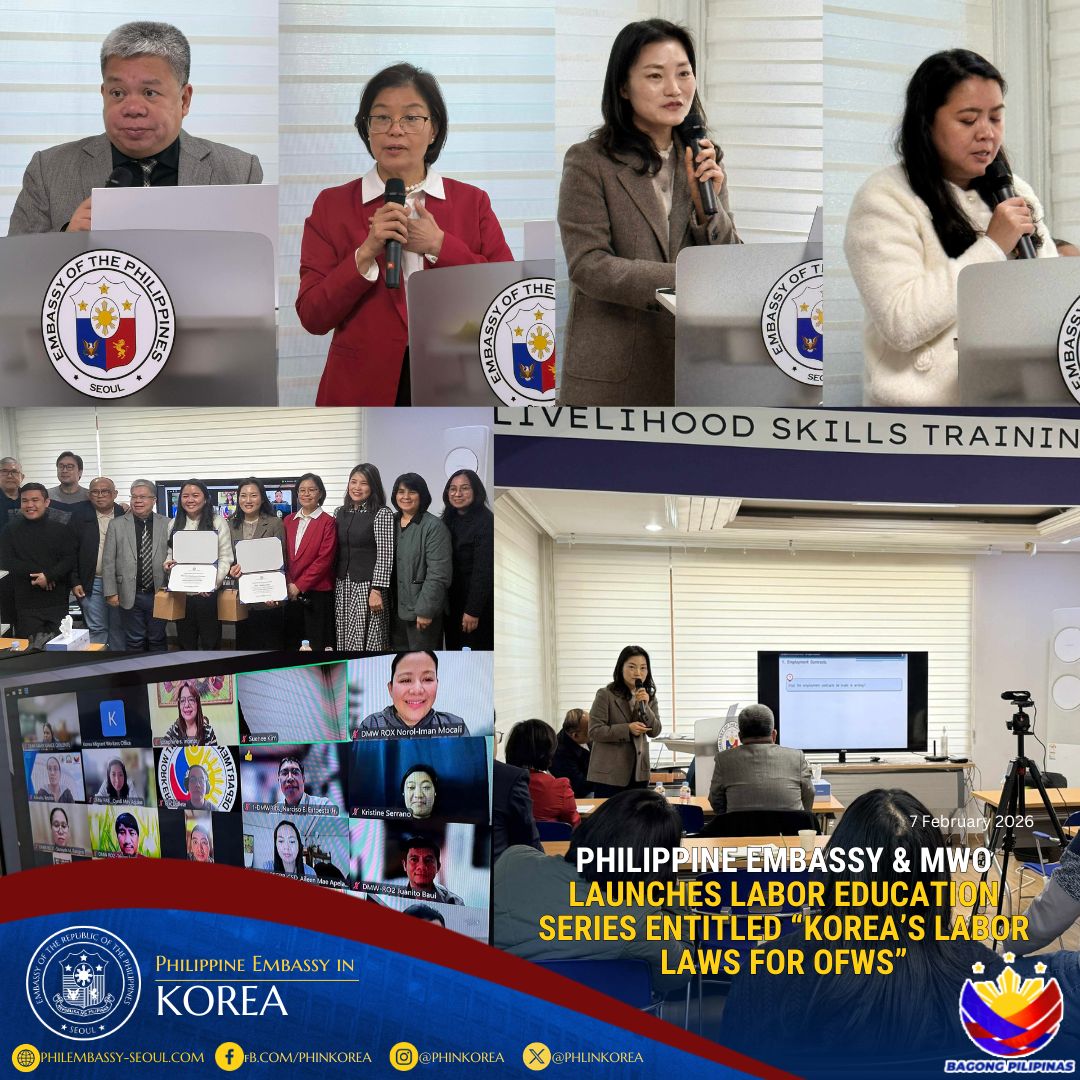
7 February 2026, Seoul – The Philippine Embassy, through the Migrant Workers Office (MWO), formally launched its Labor Education Series titled “Korea’s Labor Laws for OFWs” on February 7, 2026 for Embassy personnel, attached agencies, and concerned offices of the Department of Migrant Workers (DMW).
The activity was conducted in a hybrid format, combining face-to-face and online participation, with 13 people attending in person and 75 people joining virtually.
Chargé d’Affaires Edwin Gil Mendoza delivered his welcome remarks, highlighting major labor and immigration changes in Korea for 2026 and their direct impact on foreign workers. These include a higher minimum wage, updates to the E-9 and E-8 visa programs, expanded industry quotas, and a shift toward digital compliance through the HiKorea platform. These developments were presented as opportunities to enhance protection, fairness, and working conditions, while emphasizing the responsibility of workers to remain informed and compliant.
Resource Speaker, Labor Attorney Ms. Suehee Kim, provided a comprehensive discussion of Korean labor law, including employment contracts, working conditions, termination and resignation procedures, industrial accidents, and workplace sexual harassment. She also covered significant updates to Korean labor laws for 2026, including the increase in Korea’s minimum wage and other key policy developments affecting Overseas Filipino Workers (OFWs).
The Embassy and the Migrant Workers Office reaffirmed their commitment to supporting and empowering Filipino workers by providing guidance, knowledge, and assistance before issues arise. Recent reforms—such as strengthened labor safety protections, accident insurance for small workplaces, and recognition of the “right to disconnect”—were cited as signs of progress toward dignity and well-being for workers.
The seminar concluded with an open forum and question-and-answer session facilitated by the Labor Attaché, allowing participants to raise practical concerns and clarify labor-related issues.
We extend our sincerest appreciation to our partner, Director Katherine Corteza of Itaewon Global Village Center, and to all the participants for their active engagement. Through initiatives like this, MWO Seoul continues to strengthen its commitment to protecting the rights and welfare of Overseas Filipino Workers (OFWs) in South Korea and to equip government personnel with the knowledge needed to better assist them. END
 November 04, 2026
 November 03, 2026
 October 31, 2026
